


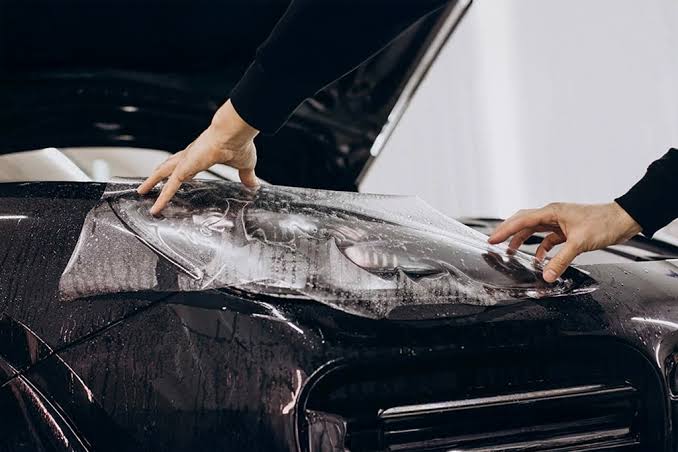
How PPF Is Applied on a Luxury Car in 2026: Step-by-Step Process, Time & What to Check in Delhi NCR
Professional PPF application in Delhi NCR takes one day for a full front and 2–4 days for full body. See the 10-step process, cure time, and what to check before you book
Quick answer: Professional PPF application is a wet-install process done in a dust-controlled studio. The car is inspected, washed, decontaminated and, if needed, paint-corrected. Computer-cut film is aligned with slip solution, squeegeed, edge-wrapped and heat-set.
Full front = about 1 working day. Full body = 2 to 4 days. Do not wash the car for 7 days while the adhesive cures.
Luxury cars in Delhi NCR do not live an easy life. Heat sits on the clear coat. Construction dust works into the paint. Highway stone chips find the front bumper first. Paint Protection Film is the physical shield most owners choose against that wear.
The film itself matters. The way it is applied matters just as much.
This guide walks through how PPF is actually applied at a professional studio in Delhi and Gurugram in 2026 — what happens to your car, how long it stays, what can go wrong if the job is rushed, and what you should check before you book.
What PPF application actually means
Paint Protection Film is a clear thermoplastic polyurethane (TPU) sheet with an adhesive layer.
It is not vinyl wrap. It is not ceramic coating.
Wrap changes colour. Ceramic adds gloss and chemical resistance. PPF is a physical skin that takes the hit from chips, light scratches and chemical stains so the factory paint does not.
Application is the process of bonding that film to each panel so it looks invisible, follows every curve, and stays down at the edges through Delhi heat, monsoon humidity and high-pressure washes.
Premium films used on luxury cars in this market — including XPEL, STEK, Llumar, Saint-Gobain and 3M — are typically in the 6–8 mil range (about 150–200 microns). Most include a self-healing top coat. Minor swirl marks can relax out with warm sun or warm water.
Self-healing only works if the film was applied cleanly and was not overstretched.
How long does PPF installation take in Delhi NCR?
Time depends on coverage, body shape and whether the paint needs correction first. These are realistic studio times for 2026 — not the “full body in four hours” claims you will hear at some workshops.
Coverage | Typical studio time | When you usually collect Bumper, mirrors, door cups | 3–5 hours | Same day Full front (bonnet, bumper, fenders, mirrors) | 6–10 hours | Same evening or next morning Full front + rockers / A-pillars | 1–1.5 days | Next day Full body sedan (3 Series, A4, C-Class, Model 3) | 2–3 days | After overnight rest + QC Full body SUV / EV (X5, G 63, Urus, Model Y, Harrier EV) | 3–4 days | After next-day inspection
There is a difference between hands-on labour and the time your car should stay in the bay. Full body film on a complex SUV can mean 16–30 hours of actual install work. The extra night is not padding. Edges need time to tack down before the car goes back onto dusty Delhi roads.
If a studio promises full body PPF with same-day delivery and no overnight check, ask what they are skipping.
Mayapuri and Gwal Pahari humidity, plus airborne construction dust, make rushed same-day full-body jobs fail at edges more often than jobs done in a dry, sealed booth.
The 10-step PPF application process
This is the process we follow at Wheel Force Studio in Delhi and Gurugram. A serious installer anywhere should be able to walk you through a version of the same sequence.
Step 1 — Inspection and documentation
Before anything touches the car, every panel is inspected under bright, angled light. Existing chips, swirls, stone marks and previous polish holograms are noted and photographed.
Whatever sits under the film is preserved exactly as it is. If a chip is not filled or a swirl is not corrected first, you will see it under a crystal-clear film for years.
Step 2 — Deep wash and decontamination
The car gets a pH-neutral foam wash, then chemical decontamination to pull iron fallout and tar. A clay treatment lifts embedded grit that shampoo cannot.
Skipping decon is one of the main reasons tiny specks appear under new film.
Step 3 — Paint correction, if the surface needs it
PPF does not hide defects. It locks them in.
Light swirl removal or a single-stage polish is often required on white, black and dark metallic luxury cars that have already seen Delhi sun and automatic washes. Correction is not upselling. It is the difference between a showroom finish under the film and a magnified map of old wash marks.
Step 4 — Final panel wipe
Each panel is wiped with isopropyl alcohol or a dedicated panel wipe to remove oils, fingerprints and leftover polish residue.
The surface must be chemically clean. Adhesive will not bond to wax.
Step 5 — Computer-cut pattern preparation
Film is cut from a digital pattern library for the exact make, model and year — XPEL, STEK, Llumar and Saint-Gobain all maintain professional pattern databases.
Pre-cut kits reduce stretching, waste and edge lift.
Hand-cut film from a bulk roll can still look good in skilled hands. On flared arches, complex bumpers and EV cladding it is slower and more likely to be overstretched.
Overstretched film is the film that lifts after the first monsoon.
Step 6 — Slip solution and positioning
A soap-and-water slip solution is sprayed on the panel and on the adhesive side of the film. That lubrication lets the installer slide the piece into alignment before it grabs. Alignment is checked against body lines, sensors, cameras, badges and shut lines.
On modern Mercedes, BMW, Porsche and Tesla panels, camera washers and radar modules leave no room for a casual fit.
Step 7 — Tack, squeegee and water-out
Once the piece sits correctly, tack solution is used at anchor points. A soft-edge squeegee works from the centre outward, pushing slip solution and air to the edges in overlapping strokes.
Rushing this step traps moisture that later shows as haze or a bubble.
Step 8 — Edge wrap and tucking
The film is wrapped around bumper returns, mirror caps, door cups and leading edges so you do not see a raw cut line.
Unwrapped edges are the first place Delhi high-pressure wash guns and monsoon water get underneath.
Edge wrap is the unglamorous part of the job and the part most budget installs skip.
Step 9 — Controlled heat forming
Gentle, controlled heat helps the TPU relax into concave areas and lock the wrapped edge.
Too much heat distorts the film and can damage adjacent plastic or sensors. This is a trained-hand step, not a heat-gun shortcut.
Step 10 — Overnight rest and quality check
The car stays indoors. The next day the installer rechecks edges, sensor windows, door shuts and high-stretch zones. Micro-trim and a final heat set happen before handover.
That second look is why a proper full-body job is measured in days, not hours.
Pre-cut PPF vs hand-cut PPF
Both methods can produce a clean car. They are not equal on warranty, speed or long-term edge stability.
Point | Computer-cut (pre-cut) | Hand-cut from bulk roll Fit accuracy | Pattern matched to the exact model | Depends entirely on the installer Stretch on curves | Lower | Higher Edge lift risk | Lower when wrapped correctly | Higher if the piece was forced Warranty registration | Easier with XPEL, STEK, Llumar, Saint-Gobain | Often harder to register as genuine Best for | Luxury cars, SUVs, EVs, complex bumpers | Simple panels, small repair pieces
At Wheel Force Studio we use computer-cut patterns from the brands we are authorised to install. That is how manufacturer warranties get registered at fitment — including XPEL, which we now install as an authorised studio in Delhi and Gurugram.
Should paint correction be done before PPF?
Yes — whenever the paint is not already defect-free.
Film is optically clear. Swirls, holograms, water spots and industrial fallout look sharper under new PPF than they did on bare paint.
On a new car with light transit marks, a careful decon and a light refinement is usually enough. On a two- or three-year-old Mercedes, BMW or Range Rover that has been through monsoon and basement parking, skipping correction is how owners end up unhappy six weeks later.
PPF application vs ceramic coating application
These are different processes. Combining them is common on luxury cars in Delhi NCR.
Order matters: PPF first. Ceramic after the film has cured.
** | PPF application | Ceramic coating application** What it is | Physical TPU film bonded to paint | Liquid polymer that cures on the surface Main job | Chip, scratch and impact protection | Gloss, hydrophobicity, easier washing Studio time | Hours to several days | Usually same day after prep Cure before first wash | About 7 days | Typically 5–7 days Lifespan | 7–12 years on premium film | 2–5 years depending on grade Best used as | Armour on impact zones or full body | Top layer on paint or on cured PPF
Why PPF lifts or looks poor after application
Most failures blamed on “bad film” are application or aftercare failures.
These are the patterns we see most often in Delhi NCR:
• Dust nibs under the film — install done in an open or dusty bay. • Overstretched bumper corners and wheel-arch lips — the film was forced instead of patterned. • Raw, unwrapped edges on mirrors and door cups — high-pressure wash water gets underneath. • Washing on day two because the car picked up construction dust — the adhesive had not finished bonding. • Low-grade vinyl sold as PPF — it yellows, peels and has no self-healing coat. • No registered brand warranty — if the studio cannot tell you the exact film and plot the job, treat the quote with caution.
A four-hour “full body” promise usually means one or more of those corners were cut.
How do you care for PPF in the first week?
You can usually drive the same day. You should not wash it.
Curing continues while you drive. Water pressure and automatic brush washes do not help the adhesive.
Timeframe | Safe to do | Avoid First 24–48 hours | Normal city driving | Heavy rain, tree sap, highway gravel Days 3–7 | Leave the film alone | Any wash, wax, polish or coating Week 2 onward | Hand wash with pH-neutral shampoo | Automatic brush tunnels, harsh degreasers Month 1 onward | Normal careful wash routine | Ignoring lifted edges — reseal them early
Delhi-specific note: a dusty car on day three looks worse than it is. Dust sitting on top does less damage than a sponge and a pipe on day three. Wait the full 7 days.
What to check before you book a PPF studio
Ask these six questions. A proper studio will answer them without hesitation.
- Which exact film brand and series will go on my car — XPEL, STEK, Llumar, Saint-Gobain, 3M or something else?
- Is the pattern computer-cut from the manufacturer library, or hand-cut from a roll?
- Is the bay enclosed and dust-controlled?
- Is paint inspection and correction included, or quoted separately?
- Will the manufacturer warranty be registered in my name at fitment?
- How many days will the car actually stay — not the marketing number, the real one?
How much does professionally applied PPF cost in 2026?
Application quality and film brand move the price more than square feet alone. In Delhi NCR in 2026, realistic bands look like this:
• Partial front (bumper, bonnet, mirrors): ₹25,000 to ₹80,000 • Full front: ₹45,000 to ₹1,30,000 • Full body premium film: ₹1,30,000 to ₹2,50,000+ • Full body plus ceramic top coat: ₹1,60,000 to ₹2,80,000+
A cheaper quote is not automatically a better decision. Unbranded film applied in a dusty yard is the most expensive PPF you can buy, because you pay twice — once now, and again when it is stripped and redone.
Full price breakdown by coverage and brand: https://wheelforcestudio.com/
Frequently asked questions
How is PPF installed on a car? A trained installer inspects and cleans the paint, corrects defects if needed, then applies computer-cut TPU film with slip solution. The film is squeegeed from the centre out, wrapped at the edges, heat-formed and left to cure. Do not wash for about 7 days.
How long does full-body PPF take in Delhi or Gurugram? Sedan: 2–3 days. Large SUV / EV: 3–4 days. Full front: 1 working day. Anyone promising a complete full-body install and handover in a few hours is compressing prep, edge work or the cure check.
Is PPF visible after application? Quality gloss film is designed to be optically clear. On a clean, corrected panel you should see paint, not plastic. Matte or satin films are visible by design. Poor application — dust, stretch marks, high edges — is what makes gloss film look obvious.
Does self-healing work immediately after application? The top coat can relax light swirls with warmth from the day it is fitted. Deep cuts that reach the TPU core will not heal. Self-healing also does not fix a dirty or overstretched install.
Can I apply ceramic coating on new PPF? Yes — after the first week. Coating on top of PPF adds gloss and makes washing easier. It does not replace the chip protection of the film.
Can old PPF be removed and replaced? Yes. Professional removal uses controlled heat so factory paint stays intact, provided the original paint was sound. Fresh film then follows the same 10-step process.
Should I get PPF or ceramic coating first? PPF first for chip protection. Ceramic after the film cures. Ceramic alone will not stop a highway stone.
Which cars need extra care during application? Large SUVs and EVs take longer because of cladding, camera packs, charging flaps and complex bumpers. White and black cars show dust and stretch more clearly, so prep and lighting have to be stricter.
The Wheel Force Studio standard
Wheel Force Studio is the detailing arm of a luxury-car workshop that has been in Delhi since 1989.
Delhi: B-80, Mayapuri Industrial Area Phase 1, New Delhi
Gurugram: Plot No. 7, Gwal Pahari
We are authorised to install XPEL, Saint-Gobain, Llumar, STEK and 3M. Patterns are computer-cut. Warranties are registered at fitment. Cars stay long enough for prep, wrap and a next-day check — not just long enough to look finished under showroom lights.
If you are deciding between full front and full body, or between film brands, bring the car in. An inspection under proper lighting is more useful than a quote sent over WhatsApp.
Book a PPF inspection
Delhi studio
B-80, Mayapuri Industrial Area Phase 1, New Delhi 110064
Call / WhatsApp: +91 87663 60204
Gurugram studio
Plot No. 7, Gwal Pahari, Gurgaon–Faridabad Road, Gurugram 122003
Call / WhatsApp: +91 88513 12181
Email: wheelforce.x@gmail.com
Website: www.wheelforcestudio.com
Related reading
How Much Does Full PPF Cost in Delhi NCR in 2026
https://wheelforcestudio.com/
Wheel Force Studio Is Now an Authorized XPEL PPF Installer
https://wheelforcestudio.com/
How Long Does Ceramic Coating Really Last?
https://wheelforcestudio.com/
Paint Protection Film only works as well as the day it was applied. In Delhi NCR, that day should be unhurried, documented and done with a film you can name.